
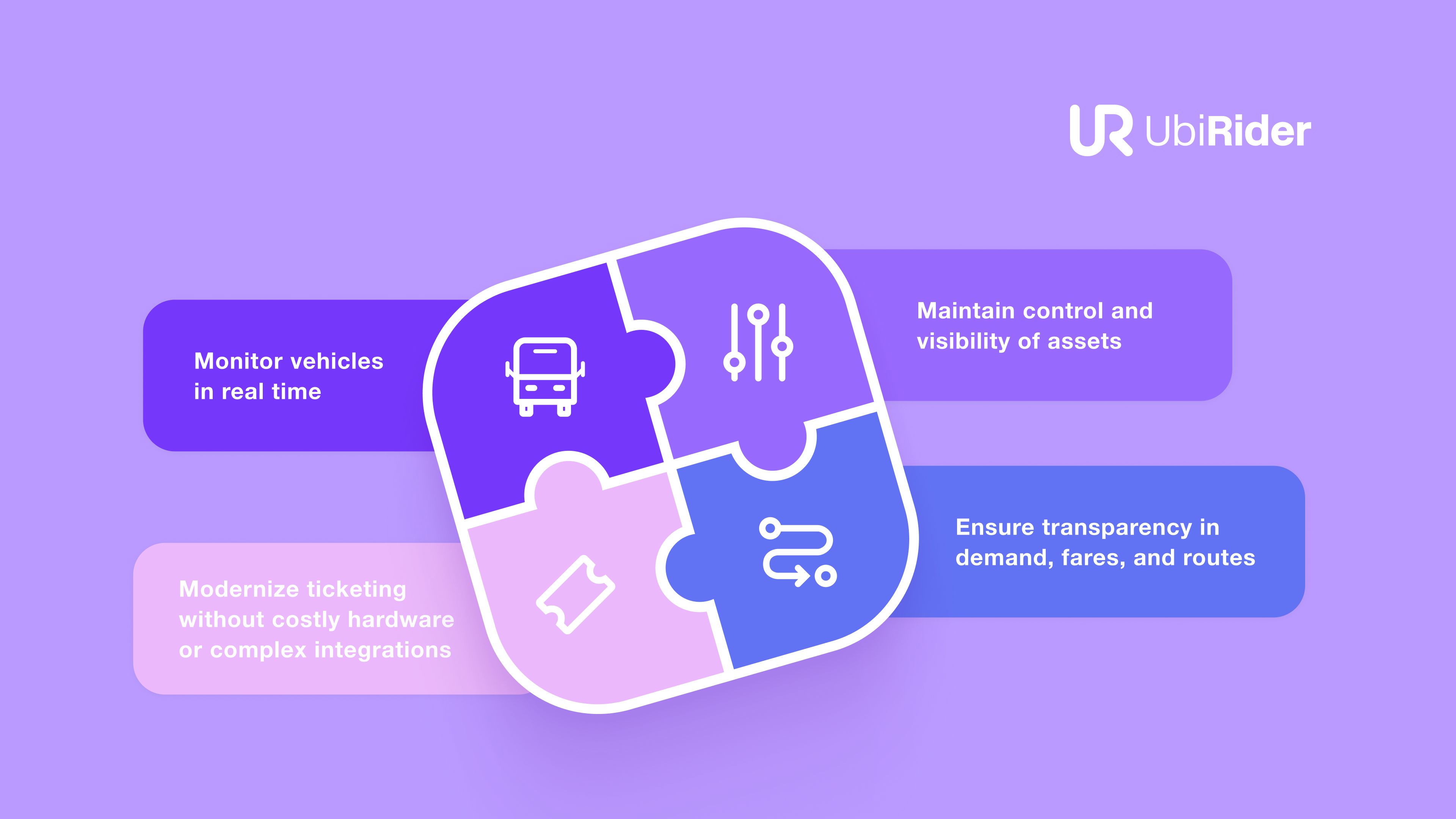
From fragmentation to unity: empowering local operators
Across the United Kingdom, bus services outside London face a complex set of challenges. Local operators—often running smaller fleets—are tasked with juggling multiple contracts, from school transport to rural services, all while trying to compete with larger providers and respond to shifting passenger expectations. Yet their greatest challenge may not be external pressures, but internal fragmentation.
Systems for scheduling, ticketing, fleet monitoring, and compliance are often siloed, disconnected, and inefficient. For operators already working on razor-thin margins, the inefficiency of this fragmentation represents both a financial strain and a barrier to growth.
The question is clear: how can local operators move from fragmentation to unity?
Fragmentation: a silent cost in regional transport
The legacy of deregulation continues to shape today’s challenges. Since 1986, the bus market outside London has been highly decentralised. While this has fostered local responsiveness, it has also led to a patchwork of providers with little consistency in systems or standards. Many smaller operators rely on basic tools—often spreadsheets for scheduling and compliance—layered on top of legacy ticketing or fleet systems.
The result is a lack of integration. A schedule change may not flow automatically to ticketing, leaving discrepancies in fares or timetables. Revenue figures might be reported weeks late, long after decisions should have been made. Compliance teams often spend days stitching together reports from multiple sources. What seems like small administrative inefficiencies compound over time, eating away at margins and eroding the ability to make informed, timely decisions.
The pressures are even greater in rural areas. A Guardian investigation recently found that nearly a fifth of England’s rural bus services have disappeared in the last five years, highlighting how fragile these networks have become. For operators left to serve these communities, wasted minutes and mismatched data can make the difference between sustainability and closure.
The case for unity
Bringing fragmented systems into a single operational view changes the game. Instead of juggling disconnected tools, operators can manage schedules, fares, fleet assignments, and compliance within one environment. This allows managers to understand how routes are performing financially, whether vehicles are being used efficiently, and how passenger demand is shifting—all in real time.
The transition doesn’t have to be all-or-nothing. Incremental adoption, where scheduling might be integrated first and other functions follow, allows operators to modernise without taking on unnecessary risk. Standards such as ITxPT (Information Technology for Public Transport) are helping by making onboard systems more interoperable, from ticket validators to telematics units. This reduces the cost and complexity of integration while giving operators the confidence that today’s investments will still fit tomorrow’s needs.
Most importantly, a unified view shifts operators from being reactive to proactive. Rather than spending time reconciling reports, managers can focus on adjusting routes, improving load balance, or planning ahead for new tenders.
Building competitive edge
For local operators, contract management and bidding are central to survival. Yet preparing bids or demonstrating compliance often requires pulling together fragmented data. A unified system changes this dynamic by embedding contract requirements into daily operations. Reports can be generated automatically, audits become less daunting, and tender submissions can be grounded in accurate passenger and revenue data.
This shift is also about mindset. Many small and mid-size operators operate in what might be called “survival mode,” concentrating narrowly on cost control and fare evasion. By consolidating their systems, they can unlock growth potential—whether through demand forecasting, smarter scheduling, or exploring partnerships with schools, businesses, and local authorities. Instead of reacting to immediate pressures, operators gain the tools to shape their future strategy.
Lessons from other markets
Examples from abroad show what’s possible. In Germany, platforms such as IVU.suite have demonstrated the benefits of managing planning, dispatch, ticketing, and fleet analytics within a single architecture. While these solutions are often aimed at large networks, the principle of integration applies equally to smaller fleets.
Closer to home, UK-based innovations like Omnibus EPM have begun to bring similar benefits to regional operators by consolidating timetables, tenders, and compliance management. These tools show that integration is not just for big-city systems—it can be adapted to the needs and budgets of smaller players as well.
Toward integrated local transport
The value of unified systems extends beyond individual operators. As authorities explore bus franchising and integrated transport models, operators who can plug into a larger ecosystem will be at an advantage. Greater Manchester’s Bee Network aims to bring buses, trams, and cycling infrastructure under a single brand, while Liverpool plans to introduce franchised bus services from 2026.
For operators, this shift means that the ability to share real-time data on routes, performance, and passengers will become essential. Those who have already moved from fragmentation to unity will be better placed to participate in and benefit from these integrated networks.
Behind the technology are the people who make bus networks run. Fragmentation has real consequences for them. Drivers deal with inconsistent information when schedules and ticketing don’t align. Managers spend long hours wrestling with paperwork instead of focusing on service improvements. Compliance teams are often under pressure to produce audit data from disconnected systems. Passengers, in turn, encounter confusion when fares and timetables don’t match up.
Unifying operations improves not only efficiency but also the daily experience of everyone involved. Drivers get clearer assignments, managers gain time for strategy, compliance officers have reliable data at hand, and passengers enjoy more reliable services.
Looking ahead: a strategic imperative
The transport sector is entering a period of profound change. Passengers expect contactless payments and real-time information as standard. Authorities are demanding better accountability for public funding. Rural communities are increasingly at risk of being cut off.
In this environment, fragmentation is more than an inconvenience—it is a liability. Unity, on the other hand, offers a path to resilience and growth. By consolidating systems into a single view of routes, revenue, and riders, local operators can reduce costs, strengthen their competitiveness, and prepare for the integrated networks of the future.
For decades, fragmentation has been the hidden tax on UK bus operators outside London. It drains time, creates blind spots, and limits strategic options. Yet the tools and standards now exist to change that reality.
Moving from fragmentation to unity is not just about software; it is about creating a foundation for stronger operations, better passenger experiences, and more sustainable networks. For local operators, embracing this shift is no longer optional—it is the key to thriving in a rapidly evolving public transport landscape.











.png)
.png)


.png)


.png)